TWOARABMINDS' Sofiane El Bekri on Inheriting Influence
Sofiane El Bekri, the creative director behind TWOARABMINDS, on building taste, and turning a decade of work into something you can hold in your hands.

Influence is rarely something you go looking for. More often it arrives before you have the language to name it, in the clothes someone wears, the music they listen to, and the way your parents carry themselves around you when you’re young.
Sofiane El Bekri was born on February 22nd. Both of his parents were born on the 11th. It’s the kind of detail you might overlook if it’s mentioned in passing, but in his case, it’s the basis of his story. He’s the sum of two lives that were already in motion.
We meet at the PUBLIC during NYFW in September, ostensibly to work through the details of his Romantic Gangsta book launch, which is bringing him to New York for a few days. But Sofiane and I have been in each other’s orbit long enough that the conversation doesn’t stay logistical for long. It rarely does with him. By the time we settle in, we’re already somewhere else entirely, bouncing ideas off each other, which is probably why this felt like the only right place to start.
Before TWOARABMINDS, before Paris, and before anything that could be defined as work, there was home. His mother, Hafida, was born in Lille to Algerian parents who were traditional enough to push their children toward assimilation, toward French friends and ways, away from anything that would mark them as too Arab. His father, Amor, came from Tunisia, and settled in Ghent, Belgium where there was almost no Arab community to speak of. The American soft power was present in the lives of both. Amor built himself into someone who wore Timberlands and bleached his hair, and Hafida wore big hoop earrings, emulating what they saw on TV. They met in Ghent, and when Sofiane was born, had already understood the weight of the culture they were participating in. His mother knew every word to “The Boy is Mine”, and his aunt kept Usher’s 8701 on rotation.


His parents separated when he was one, and his mother moved them to Lille, where she enrolled him in the only private school in the city. It wasn’t an easy decision, but as a single parent, it felt like the obvious one. She paid for it by cleaning homes and babysitting, often for the same families whose kids he sat next to in class. He would spend his days inside those classrooms, then return to a different reality at night, and the skill he learned early was knowing how to exist in both spaces without making the contrast too obvious. For an Arab kid in that environment, the gap between who he was and who he was assumed to be was information to collect, and he paid close attention to it.


He skipped a grade young, and school came easily until high school, when football had taken over enough of his attention that he never took his final exams to graduate. The academy had become the primary structure of his life by then, and within it he had already established himself as something other than just a player. He was the flyest kid on the team, the one who cared about what he was wearing, and his Limewire playlists were never lacking. His teammates trusted his taste in music, then his opinions on what they should wear, and he established his place in the group as a reference point without trying to be.
At fifteen, when his brother’s father left, he became the man of the house. He decided to play in a league in Australia to make some money and learn English, but he soon suffered back-to-back injuries that ended the football trajectory completely. He came back to Lille, took his mother to Bali, and moved to Paris in June 2020.


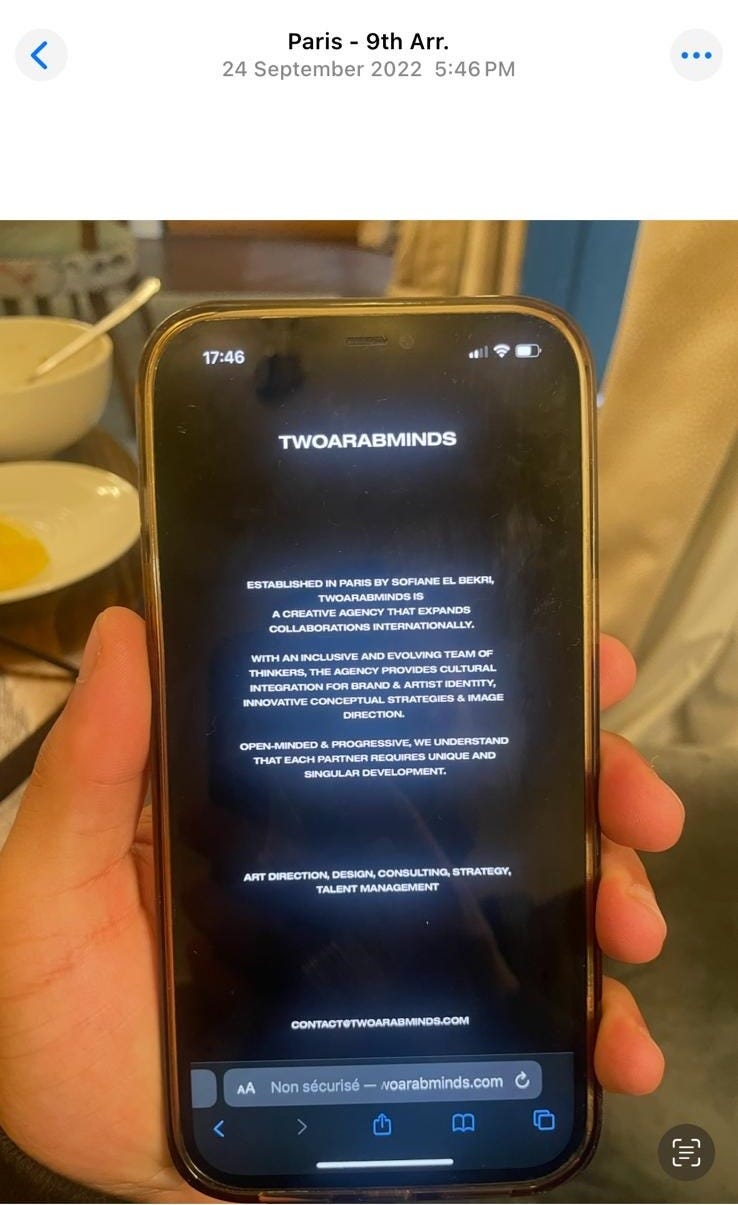
TWOARABMINDS began as an extension of what he’d been doing in real life: recognizing patterns, noticing shifts, and understanding what carried weight. Digital platforms like Tumblr and Hypebeast had been daily reading for years already, and when he and his cousin, who was working at Balenciaga at the time and understood the world Sofiane was orienting toward, started the Instagram page together, there was no blueprint, just a shared commitment to posting images that felt culturally alive. What they learned quickly was that consistency mattered more than almost anything else. Sofiane followed accounts for visibility then unfollowed, tested new things to see what landed, and stayed in constant engagement, learning in real time how attention moves and what it takes for something to gain traction. When Complex reposted them, it was a small moment, but it was the first time the page crossed a real threshold and saw a surge in new followers and interest.
His early connections didn’t come through formal channels, but through proximity and recognition, through people seeing what he was doing, liking it, and closing the distance between observer and participant. The domino effect that followed introduced him to most of the people who mattered next.
TWOARABMINDS was operating like something that could easily become a brand, and it kind of did. The idea was simple enough: he would take the material he’d been saving and translate it into product, and see what would happen offline. The first piece was a t-shirt that read “ain’t here for te quieros”, a phrase that was consistent with his life’s theme of taking things that don’t usually sit together and making them coexist. Two weeks before the drop, he and his cousin parted ways over a disagreement about the future of what they were building and what it should become.
Sofiane moved forward alone and the shirt dropped, and it reached the right people because of the work he had already put in. Six months later, he followed it with hoodies and sweats, expanding the world of TWOARABMINDS offline and into everyday life.


Around that time, a group of friends suggested he shoot a video to accompany the launch, and that opened up something new. For the first time, he was responsible for constructing the image of something rather than just selecting it.
Work started coming in, requests for direction and input on ideas, and he took on every job, not yet knowing what the roles were called or where they would lead. A friend brought him in as a styling assistant, which introduced him to the mechanics of how shoots run, how you communicate with brands, and what the structure behind a visual actually looks like from the inside. He took notes on all of it, and then used the language he learned in those email threads to start reaching out to brands himself, with more precision about what he was offering and a clearer sense of his own terms.


From there, things started to move faster. A client in Dubai began paying him to style her, which gave him both financial stability and a sense of validation that what he was doing was sustainable. He was still crossing Paris on his VanMoof (if you’ve seen Sofiane around Paris, you’ve seen his beloved bike), carrying bags of designer samples, and parking it outside of sets, when a close friend asked him to come along to deliver a Louis Vuitton jacket to Hamza. It was super casual and nothing more than a drop off, but Sofiane, who moves through rooms easily, found himself back in Hamza’s hotel room the next day with racks of clothes for him to choose from. That said enough on its own. What followed was styling work across Hamza’s video sets, tour stops, and appearances throughout Europe. Everything compounded steadily.


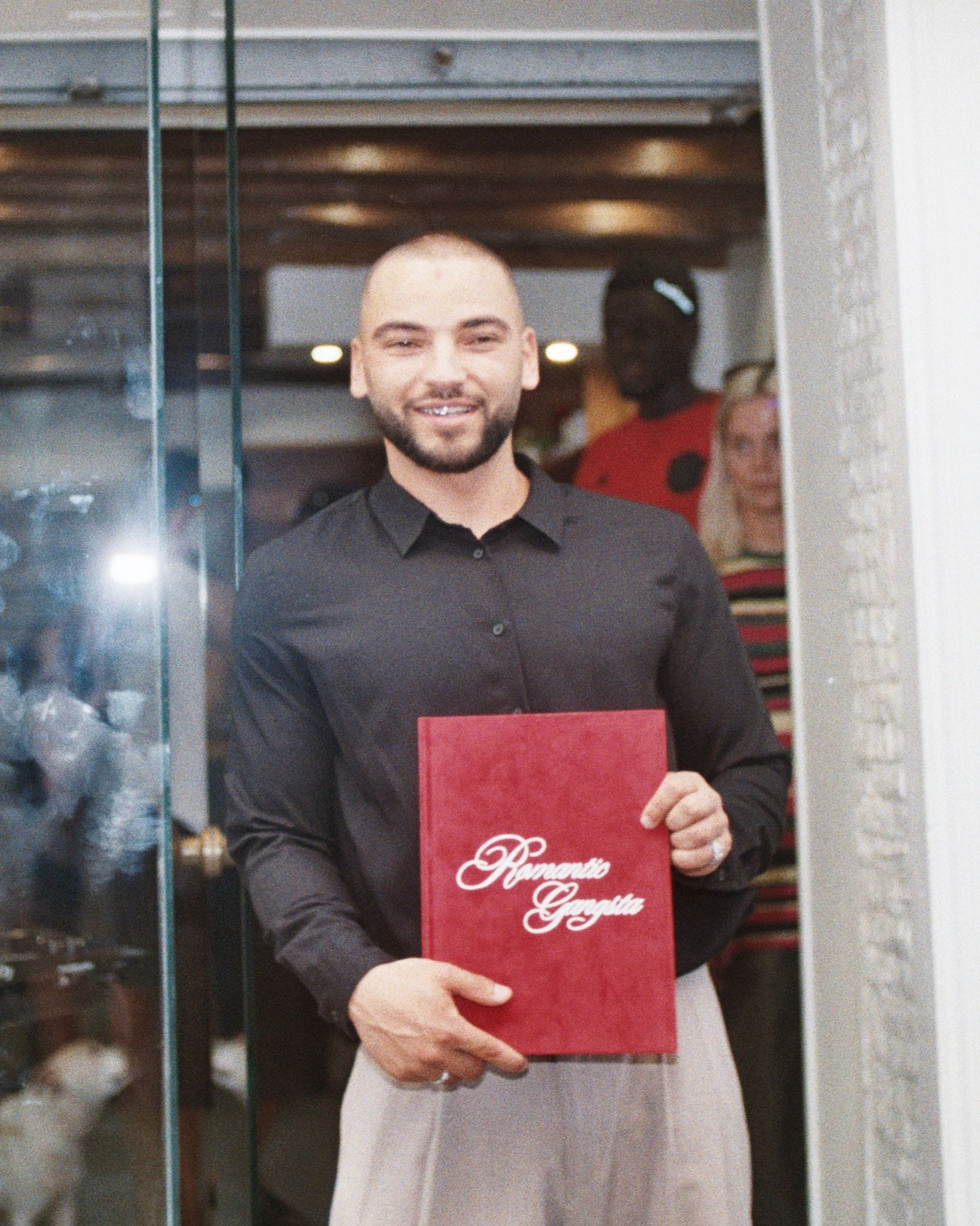
By 2025, he decided that he wanted to make something permanent again. He had attended a release event for a Middle East Archives book, and observed how people engaged with something physical in such a meaningful way. He decided on a book of his own, and the concept came easily to him. Romantic Gangsta had been a phrase in his vocabulary for years, naming the tension between romance and survival that runs through his work (and his father’s name is Amor, so it was never going to be called anything else). He produced the book himself, curating photos taken by and featuring friends and people he admires, and built out a strategy for selling it, securing placement at his favorite bookstore in Paris, Yvon Lambert, and hosting release events of his own. The community that showed up in Paris and then in New York was the one he had been building for years, and he sold every copy of the book.
The angel number 222 (as in 2/22, Sofiane’s birthday) is sometimes called the Master Builder, understood as the energy of translating vision into form through discipline and patient action. It holds true here. Sofiane never had to go looking for his references because he grew up inside of them. The instinct to pay attention was there early.